Thursday, October 16, 2008

Review: Scaredy Squirrel

By: Melanie Watt

Kids Can Press; 2006; 40 pages

Picture Book;

Award Winner: ALA’s Notable Children’s Book; Cybil; Schwartz Children's Book Award for Children’s Picture Book; Amelia Frances Howard-Gibbon Illustrator's Award; Blue Spruce Award

Ages: Preschool to 2nd Grade

ISBN: 978-1-55337-959-1

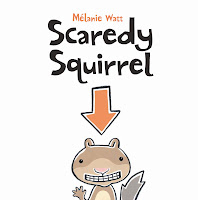
Scaredy Squirrel is afraid of absolutely everything, including green martians. He develops an emergency kit, an exit plan, and never leaves his tree. When Scaredy Squirrel is forced out into the world, he learns that "new" and "different" do not always mean "bad" and "scary." He finds his courage, and begins to embrace adventure.

My Thoughts:

This book should be dedicated to neurotics everywhere. As someone who has control issues, I was able to identify with the main character in strange and unusual ways. Scaredy Squirrel has an escape plan and an emergency kit which addresses every possible eventuality. (As a kid, I had a plan for what to do if my house was invaded by raptors from the Jurassic Park films.) What is great about this book, is that it doesn't minimize Scaredy Squirrel's fears. It doesn't ever diminish him as a squirrel for having them. Rather it shows how, by facing his fears, he is able to lead a richer and more fulfilling life. That is a concept that is important for kids. They need to know that it is ok to be afraid, but that they can face those fears. At the end of the book, Scaredy Squirrel is still nervous...he isn't "fixed" as one would suppose. The resolution comes from the fact that he is now willing to step away from his tree and try new things.

The text in this book is at a fairly simple level. It is engaging enough to make it a good read aloud book, but easy enough that insecure or early readers can try it on their own. The pictures are also incredibly engaging. They are extremely bold in their lines, and the colors (while limited) make a statement. Many books about fear depict the "scary" things in a dark and menacing way, that can actually CAUSE children to be more afraid. This book, however, shows them in a light and humorous way, that is very non-threatening. Children can empathize with Scaredy Squirrel without joining in his paranoia.

The Thoughts of Others:

Publisher's Weekly had a very positive 2006 review of Watt's book. They noted that she "largely dispenses with conventional visual storytelling," using instead "goofy charts and diagrams" which "spoof all the sincerely inane worksheets that are the staple of elementary school homework." (This was something I had not actively picked up on, but is useful in teaching literacy skills. Children need to learn to interpret diagrams and charts in addition to reading traditional text.)

School Library Journal also picked up on the plethora of diagrams versus standard text. They felt, in their 2006 review, that the main character was endearing, and that the humor would appeal to children.

Thursday, October 9, 2008

Review: Animalia

By: Graeme Base

Harry N. Abrams; 1987 (2004 reprint); 32 pages

Picture Book; Alphabet Book

Grades: Kindergarten thru Adult

ISBN: 0-8109-1939-7

A menagerie of animals romp through the alphabet doing all sorts of alliterative activities.

My Thoughts:

This is one of the most beautifully illustrated alphabet books I have ever clapped eyes on. It goes far beyond the "A is for Apple, B is for Ball" format of this genre's majority. Each letter is represented by a different animal doing something odd and interesting in an alliterative format. (For example: Diabolical dragons daintily devouring delicious delicacies.)

Honestly, the vocabulary is such that younger children will most likely be unable to read it independently. So, as far as its use as a typical alphabet book, it would be less than desirable. Yet, while the text may be over their heads, the beauty and intricacy of the illustrations will keep them enraptured! It also is a delightful read aloud book. The vocabulary can be made sense of through context and depiction. (I have never agreed with talking down to children. This book is a fun way to expose kids to words like: basking, impromptu, jovial, and upending.) Furthermore, the book can be used to teach older elementary students about the literary technique of alliteration.

The Thoughts of Others:

Aussie Reviews
had some very insightful comments about this classic in a review by Tash Williams. Tash described the animals images as "bizarre and interesting." Tash also noted the broad based appeal, citing that various age groups are "looking at the levels that are appropriate [to them]...unaware of shared levels within."

Publisher's Weekly also reviewed the book when it was originally released in the 80's. While the overall review was positive, they did point out a few of its shortcomings. These included that "it lacks a clear conceptual coherence or unity of action or meaning on every page."

Review: I love My New Toy

By: Mo Willems

Hyperion Books; 2008; 57 pages

Picture Book. Easy Reader

Grades: Kindergarten- 2nd

ISBN: 978-142310962-4

Piggie and Elephant's friendship is put to the test when Elephant accidentally breaks Piggie's new toy. Luckily, their relationship is not broken forever, and neither is the toy! (It turns out it was supposed to break. Go figure!)

My Thoughts:
I stand in awe of Mo Willems yet again. How he is able to depict such a range of emotions with such minimal artwork and text is beyond me. His use of text balloons makes learning to read more fun. (Reminiscent of comic strips, reading dialog in balloons is less arduous and more straight forward for readers.) Also, rather than using adverbs to express emotions, Willems employs the more direct means of emphasizing text through font size and typeface. (Anger is expressed in large, bold, capital letters. Sadness is small and fine.)

In short, this is a great easy reader book. It has limited vocabulary usage, making it easier for children to practice basic words when they are trying to read. Also, most children were raised on Willem's other work (Pigeon, Knuffle Bunny, Leonardo, etc.) and will feel at home with this book. It is comfortable because it is familiar.


The Thoughts of Others:

Hornbook's review from July 2008 agrees with me that the book's limited vocabulary is ideal for young readers. The reviewer states that "the simple speech-balloon text uses a fair amount of repetition to encourage new readers." They also appreciated how "Willems skillfully conveys mood and tone through type size and his characters’ expressive body language."

Ilene Cooper at Booklist also reviewed this book in July 2008. She appreciated expressive nature of the simple illustrations, as well as that the book"offers plenty of opportunity
for new readers to learn useful words."
See, EVERYONE loves Mo Willems! (As well they should!)

Wednesday, October 8, 2008

Review: Here Comes Silent E!

By: Anna Jane Hayes

Random House; 2004; 32 pages

Easy Reader; Phonics

Ages: Pre-school - 1st Grade

ISBN: 0-375-91233-9

Silent E introduces children to how vowels change with his presence as he interacts with his friends and changes their bits to bites, pins to pines, and tubs to tubes.

My Thoughts:
The Step into Reading series is one of the most popular in my library system. Kids appreciate that they can easily find books at their level, and parents appreciate that they can find books that will help their children improve their literacy. This addition to the series is...adequate. It does what it sets out to do, but doesn't go above or beyond. In fact, Hays has to push the envelope in order to make her point on a few of her word pairs. (For example, she has Silent E turn an angry cub into a melting cube.) However, if one is to take this book as what it purports to be...a book that will teach children about silent e's, and a title in a complete phonetic series, one can't complain. (I mean, there had to be a silent e book, so it might as well be this one.) If you are looking for a Caldecott or Newbery caliber title to teach your child phonics, you will be disappointed. But if you just want to get the concept across in an entertaining manner, this book will meet your needs.

Thoughts of Others:

There was literally only 1 review that I could find anywhere...and that one was from a mom on Amazon. She thought it was a cute story. URGH! Series books are SOOOOO hard to find reviews on. I couldn't even find any reviews of the series as a whole, since it is more a system of learning than a series of books.

Review: Sticky Burr

By: John Lechner
Candlewick Press, 2007; unpaged


Graphic Novel; Hardcover


Ages: 6-10


ISBN:978-0-7636-3054-6


Sticky Burr lives in Burrwood Forest, with all the other burrs. However, he does not like doing very burr-ish things. He loves to paint, fly with his dragonfly friend, and play his ukulele rather than annoy, argue, and stick to things. The other burrs decide that Sticky Burr has got to go...that is, until his friendly attitude and willingness to help others saves the day!


My Thoughts:

I thought that this was a delightful book. Thematically, it encourages children not only to be helpful, but to be themselves.
The plot was not overworked, but at the same time it was not very involved. It is easy to follow, and would hold the interest of an early elementary school student, but may bore older students. Still, it is a great introduction into the graphic novel genre, and I believe would serve as an enticement to a reluctant reader.(See...who said that graphic novels couldn't be teaching tools!)
The artwork, while simple stylistically, is well-done and engaging. I really liked the definition and journal pages that are superimposed over a hand-made paper background. Also, the text is clear and full of interesting tidbits. There is even a song at the end, complete with music. Internet-savvy kids can also go to the official web page and explore. (The book started out as an online comic...so the page is very well done.)

The Thoughts of Others:

Booklist's Gillian Engberg reviewed the book, and was enchanted by it. Her only criticism was that "the messages about triumphing over bullies are overt."

It was also reviewed by School Library Journal, which in addition to praising the art, lauded "the lively and sometimes punny dialogue."


Review: You Can't Take A Balloon Into The Metropolitan Museum

By: Jacqueline Preiss Weitzman and Robin Preiss Glasser

Dial Books for Young Readers; 1998; 37 pages

Picture Book; Wordless Book

Ages: 4 to 7

ISBN: 0-8037-2301-6

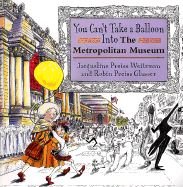
A girl is forced by a museum guard to leave her yellow balloon in his care while she tours the Metropolitan Museum. To his dismay, the balloon begins to fly away! The wordless picture book follows two narrative threads: the little girl's awe and wonder at the works of art, and the guard's desperate attempt to safely retrieve the errant balloon.

My Thoughts:
At first I was underwhelmed by this book. It was cute, and exposed children to fine art, but...meh. Then I showed it to one of my favorite 5 year olds...and he LOVED it. He is still in preschool, and appreciated having a book that HE could read to his mom. He told her the story while she looked at the pictures. Since the art is laid out in almost comic book format, I realized it was teaching him page awareness. He was having to follow the action from left to right, top to bottom. He was also learning sequencing, and narrative flow. It was amazing. All of a sudden I was looking at the book in a whole new light.

The art is absolutely enchanting. The pictures are lively, and packed with action. However, they are primarily black and white, with only the important and pertinant characters/action shown in color. The art at the Museum is actually the art at the museum spliced in. (There are photo reproductions of paintings and sculptures inset in the drawings.) My co-reviewer, the 5 year old, pointed out that the art the little girl is seeing actually mirrors the action that the balloon is doing...a painting of musicians precedes the balloon's encounter with a jazz band, a period wedding dress precede's the balloon's infiltration of a wedding party. (He is so observant!)

This book might not seem like much at first glance...but everytime I look at it I discover more gems tucked away in the illustrations. It is a feast for the eyes, and a book that actual children actually enjoy. (Which, in truth, is the best recommendation any children's material can receive!)

The Thoughts of Others:

Publisher's Weekly noticed all of the things that I had not. They truly enjoyed this book, and point out that "Glasser's drawings capture all the energy and charm of a captivating city."

Parent Council, a semi0-annual literary review that ceased publication in 2002, also reviewed the book in 2001. It was a very positive review. They note that it is a great introduction to art appreciation, helping children become familiar with pieces that make up Western Civilization's cultural canon. (Which reminded me of the Sesame Street episodes that introduced me to the Mona Lisa and other "great works.")

Thursday, October 2, 2008

Review: Opposites

By: Sandra Boynton

Little Simon; 1984; unpaged

Board Book

Ages: 6 mos- 2 years

ISBN: 0-671-44903-6

Sandra Boynton's signature and classic animal drawings depict a variety of elementary opposite pairs such as whisper and shout; fast and slow; day and night; and hot and cold.

My Thoughts:

This is a good board book. The pictures accurately portray contrasting word pairs in simple and often humorous ways. The line drawings are enticing and graphic, while the colors, though pastel, are used in bold chunks. The text itself is very simple and formulaic, consisting of merely of the two opposite phrases. The font-type often reinforces the concept as well. "Heavy" is bold, while "light" is fine, for example. As far as textual interaction goes, babies can point to which part of the illustration is which. It is very appropriate to the board book format and the age group.

However, its appropriateness aside, this is not my favorite of Boynton's books. It is missing the joy of Moo, Baa, La La La or the endearing nature of But Not the Hippopotamus. As far as its purpose as a concept book goes, it teaches the opposites, but goes no further. There is nothing surprising or special. I wouldn't rush out to buy it for a friend, or go out of my way to acquire it for a library. There are other opposite books that do the same thing, only better. (Rainbow Fish Opposites, or Yummy Yucky.)Still, if you are wanting to complete a Boynton collection or merely looking for an additional concept book, it will meet your needs.

The Thoughts of Others:

Perhaps since the book has been around for a while, or perhaps because it is a board book, I was unable to find any editorial/critical reviews. However, I found a lot of reader reviews on Amazon and other sites..some negative, and some positive:

"I found this book to be one of the most confusing and complex series of illustrations for opposites--to date. I've got a very sharp little 16 mo. old and he was completely lost, which is not typical for him. "

"The major downside in this book is the words. They still flow nicely and rhyme without strain, but they lack some little charm that almost all of the other Boynton books have."

"A cute and happy book for toddlers and preschoolers, to help introduce simple concepts of up and down, heavy and light, day and night etc. Boynton's simple, clear and cheerful drawings always appeal to little people. Good for toddlers to kindergarten age." Please note that this reviewer recommends it for a non-board book age group!