Showing posts with label behavior. Show all posts

Thursday, November 6, 2008

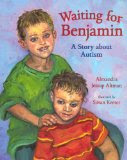
Review: Waiting for Benjamin

By Alexandra Jessup Altman; Illustrated By Susan Keeter

Albert Whitman & Co.; 2008; 32 pages

Picture Book; Realistic

Grade: K-4

ISBN: 978-0-8075-7364-8

Alexander finds himself getting increasingly frustrated with his younger brother Benjamin's behavior, until he is diagnosed with autism. At first giving into jealousy of all the attention Benjamin receives, Alexander learns patience and to appreciate Benjamin's small accomplishments.

My Thoughts:
I was initially excited to come across this book, since there are not very many books with autistic characters, and the few that do exist tend to portray the savant aspect of autism. I have a cousin who is autistic, and so am always looking for information. However, while this book is a step in the right direction, portraying a more typical autism experience, it still fell short. I worry that in some ways the book is still depicting stereotypical autistic behavior: the silence, the staring, the compulsive movements. It also shows Benjamin making rapid steps toward improvement once he is diagnosed. (And it doesn't ever explain why Benjamin's therapists come to the house rather than his going to their office...or why he gets to have 2 at once!)

In addition to story flaws, the technical aspects are not quite right either. The text explains the reactions of a fairly young older sibling. Alexander is a character that many 4 or 5 year olds would identify with. However, the text is written at a much higher level. It also discusses emotions from an abstract viewpoint that is beyond the developmental understanding of that age group. However, most older children will not identify with Alexander as much...recognizing the infantile nature of his jealousy and pettiness. In addition, most younger children will be turned off by the less than engaging illustrations while older children will be turned off by the presence of illustrations in the first place. I am glad that books are beginning to made available on this topic, and can only hope that better ones will follow this one soon.

The Thoughts of Others:

School Library Journal's Wendy Smith-D'Arezzo reviewed this book earlier this year. She pointed out that the progress Benjamin makes is not always realistic, and that the whole story's message is obvious. She did feel that it would work as a preliminary introduction for young children who have an autistic sibling.

Children's Literature's Karen Leggett saw the book as a "good icebreaker to help siblings and other youngsters understand autism and express their own feelings more openly."

Saturday, October 25, 2008

Review: Junie B. Jones and the Stupid Smelly Bus

By: Barbara Park

Random House; 1992; 69 pages

Juvenile Fiction; Series

Grades: Kindergarten - 3rd grade

ISBN: 9-78-0679-92642-9

Junie B. Jones is excited to start kindergarten and to meet new people, but she is NOT excited about riding the school bus. In fact, at the end of the school day, she decides not to ride it home again!

My Thoughts:
I thought that this book was perfect for kids who are ready to transition from easy readers to regular juvenile fiction. I had heard from some friends that they didn't care for these books because of the poor grammar. I felt, however, that the text was suited to the narrator. When read aloud, it sounds like a 5 year old is actually talking. (I especially liked how she described her classmates when she didn't know their names: that boy I can beat up, etc.) The plot moved along quickly to hold interest. The chapters were brief to give a sense of accomplishment. Most importantly, the book felt real. Junie B. is not the nicest little girl, but that makes her seem more true to life, and easier for kids to relate to.
I believe that kids will be able to identify with Junie B. even if they are already out of kindergarten.

The other thing that I loved about this book, was that it allowed me to connect with my six year old cousin who is in kindergarten. She loves these books, and loves to read them with my aunt. The repetitive nature of the series has enabled her to recite parts of each book, because the introductions are always the same. This empowers her and makes her feel like she is actually reading. (She also was very thrilled that I had to read it for homework in college...it made her feel very grown up to be reading the same books as college students!)

The Thoughts of Others:
School Library Journal's review in 1992 raved about Park's humor. They felt like this book was a great addition to a library because Junie B.'s ignorance will let "even the most insecure readers... feel superior because they know so much more than she does."

Publisher's Weekly also reviewed the book in 1992. They picked up on the realism of Junie B.'s narration, but also pointed out the book "is peppered with reader-involving questions." This would allow teachers and parents to pause and allow their students/child to interact and engage with the text.

Thursday, October 16, 2008

Review: Scaredy Squirrel

By: Melanie Watt

Kids Can Press; 2006; 40 pages

Picture Book;

Award Winner: ALA’s Notable Children’s Book; Cybil; Schwartz Children's Book Award for Children’s Picture Book; Amelia Frances Howard-Gibbon Illustrator's Award; Blue Spruce Award

Ages: Preschool to 2nd Grade

ISBN: 978-1-55337-959-1

Scaredy Squirrel is afraid of absolutely everything, including green martians. He develops an emergency kit, an exit plan, and never leaves his tree. When Scaredy Squirrel is forced out into the world, he learns that "new" and "different" do not always mean "bad" and "scary." He finds his courage, and begins to embrace adventure.

My Thoughts:

This book should be dedicated to neurotics everywhere. As someone who has control issues, I was able to identify with the main character in strange and unusual ways. Scaredy Squirrel has an escape plan and an emergency kit which addresses every possible eventuality. (As a kid, I had a plan for what to do if my house was invaded by raptors from the Jurassic Park films.) What is great about this book, is that it doesn't minimize Scaredy Squirrel's fears. It doesn't ever diminish him as a squirrel for having them. Rather it shows how, by facing his fears, he is able to lead a richer and more fulfilling life. That is a concept that is important for kids. They need to know that it is ok to be afraid, but that they can face those fears. At the end of the book, Scaredy Squirrel is still nervous...he isn't "fixed" as one would suppose. The resolution comes from the fact that he is now willing to step away from his tree and try new things.

The text in this book is at a fairly simple level. It is engaging enough to make it a good read aloud book, but easy enough that insecure or early readers can try it on their own. The pictures are also incredibly engaging. They are extremely bold in their lines, and the colors (while limited) make a statement. Many books about fear depict the "scary" things in a dark and menacing way, that can actually CAUSE children to be more afraid. This book, however, shows them in a light and humorous way, that is very non-threatening. Children can empathize with Scaredy Squirrel without joining in his paranoia.

The Thoughts of Others:

Publisher's Weekly had a very positive 2006 review of Watt's book. They noted that she "largely dispenses with conventional visual storytelling," using instead "goofy charts and diagrams" which "spoof all the sincerely inane worksheets that are the staple of elementary school homework." (This was something I had not actively picked up on, but is useful in teaching literacy skills. Children need to learn to interpret diagrams and charts in addition to reading traditional text.)

School Library Journal also picked up on the plethora of diagrams versus standard text. They felt, in their 2006 review, that the main character was endearing, and that the humor would appeal to children.

Thursday, October 2, 2008

Review: Oops! A Diaper David Book

By: David Shannon

The Blue Sky Press; 2005; unpaged

Board Book

Ages: 6 mos - 2 years

ISBN: 0-439-68882-5

Popular character David is a baby in the author's series of board books. In Oops! readers learn David's first words such as eat, ball, and dog. The accompanying illustrations are depict a mischievous and impish infant in a lively and colorful manner.

My Thoughts:

I did not particularly care for this board book. The text is simple, uses terms that the babies are familiar with, and is appropriate for vocabulary building. However, the artwork, while colorful, is too messy for my taste. Also, the attempts at humor were neither constructive nor clever.

My main concern was with the actual situations used to illustrate the text. Call me old-fashioned, but I do not want to encourage children to misbehave. "Ball" shows David breaking a window. "Eat" shows him with partially chewed food in his mouth. "Dog" shows David's upturned lunch all over the family pet. I understand that babies and toddlers make mistakes, and that accidents are something that they can relate to. David doesn't seem to feel remorse...they are shown in a purposeful manner. I think that the topic can be covered in a way that does not glorify the problem. (Uh-Oh, Calico comes to mind.)

David is depicted as such a brat that the "heartwarming" picture for Mama is no longer believable or touching...the reader just feels relief on Mama's behalf that she finally gets a short break!

Thoughts of Others:

I found, literally, no critical reviews of this work. This leads me to think that perhaps board books are not very high on reviewers' priority lists. I did find some reader reviews on various websites. A lot of them were positive, although some readers agreed with me that the book encourages bad behavior, or was merely extremely annoying to them as adults. Oh well, to each his own.