Showing posts with label picture book. Show all posts

Thursday, November 20, 2008

Review: Healing Stories

Picture Books for the Big and Small Changes in a Child's Life

By Jacqueline Golding, Ph.D

M. Evans; 2006; 343 pages

Paperback; Reader's Advisory

Adults

ISBN: 978-1-59077-097-9

A readers' advisory text which suggests various picture book titles, with accompanying bibliographic information and brief annotation, that address major events and developmental milestones in a child's life such as death, natural disaster, and separation anxiety.

My Thoughts:
I appreciated this book for what it was, a fairly specific book of reader's advisory. I think it would especially be useful having it available to parents in the children's section or reference section of the library. However, I would not recommend it as a book for individuals to go out and buy on their own. (Whereas I think that every reader should have a full set of Nancy Pearl's books on their shelves!) I liked that it only included picture books. I also liked that it included annotations. Most times titles alone will not aid a staff person or parent in determining whether the book will address their particular issue or event.

The thing I liked most was the diversity of the texts suggested. Each section included "classic" works, as well as at least one from the last 10 years. (Some were very current considering that the reference itself is a couple years old.) A great example of this is the section on Illness of Another Person. It listed both Now One Foot, Now the Other by Tomie dePaola (which I remember fondly from my childhood) and Singing with Momma Lou from 2002. Both books deal with aging grandparents.

The Thoughts of Others:
Blair Christolon reviewed this book in 2006 for School Library Journal. He felt that the book would be a great resource for "either for bibliotherapy or for theme-building for storytimes." Favorable comparisons were also drawn between this work and A to Zoo, citing the annotations in Healing Stories as very helpful.

Library Journal also reviewed the work in 2006. Reviewer Kari Ramstrom wrote that "Healing Stories empowers parents to promote development and healing...in a fun, helpful manner. She was disappointed though because while the titles suggested were useful in the categories available, she felt that other topics (such as injury or special needs) should have been included.

Friday, November 14, 2008

Review: Invention of Hugo Cabret

Written and Illustrated By Brian Selznick

Scholastic; 2007; 533 pages

Juvenile Fiction; Realistic Fiction; Caldecott Award

Grades: 3-6

ISBN: 978-04-39813-785

Hugo's father has been killed in a fire, and his uncle has disappeared. Left on his own to take care of the train station clocks, Hugo embarks on a journey of discovery. While repairing a clockwork figure that is his only link to his father, Hugo makes connections with a filmmaker, a fellow orphan, and the world around him.

My Thoughts
This was a very interesting book. It is definitely not a picture book, yet it won the Caldecott Medal...and rightly so. The artwork, though black and white, is amazing. There is depth and detail that is almost photo-realistic. Also, towards the end of the book, the drawings are intermingled with actual stills from old silent films. The pictures are also integral to the text. They are not illustrations, they are the text. I would be reading along, and then there would be a series of 4 or 5 full spread pictures that would pan across a scene, or zoom in on important actions. Each set was like a single frame of a film. It was amazing. Then the text would pick up again, only it wouldn't pick up where it left off, it would pick up where the pictures left off. It was innovative, unique, and totally enthralling.

I think that kids will love this book. The story line is interesting. Since it has a male protagonist, it will appeal to both boys and girls. Also, movies are such a huge part of modern culture that a book that addresses their beginnings will intrigue children. As will the whole notion of clockwork and mechanisms in our technological, micro-chip society. The writing is well done, the pictures are flawless. It will challenge younger readers lexically, but the pictures won't hinder older kids. (The size of the book alone will make any reader, young or old, feel like they have accomplished something upon completion.) I heartily, and without reservation, recommend this book to everyone...child and adult.

*Sidebar: I saw this at my library as an audiobook. Which literally shocked me. I am normally a huge proponent of audio and e books, but in this case I am not. DO NOT GET IT AS AN AUDIOBOOK. The pictures are integral to the text. You will not get the same experience.

The Thoughts Of Others:
Publisher's Weekly's 2007 review found the book to be "an artful blending of narrative, illustration and cinematic technique, for a story as tantalizing as it is touching." They appreciated the use of movies both in the plot and in the illustrations. They saw the book as more of an experience than merely a read.

Kirkus also reviewed the book in 2007. They drew comparisons between the book and silent films, seeing the illustrations as they pan and zoom as traditional film storyboards which often told the story better than text alone ever could have. They also liked that the book was "an homage to early filmmakers as dreammakers."

Review: Cinderella Skeleton

By Robert D. San Souci; Illustrated by David Catrow

Silver Whistle/Harcourt, Inc.; 2000

Picture Book; Fantasy

Grades: 2-5

ISBN: 0-15-202003-9

Cinderella Skeleton loses more than just her shoe when she attends the Halloween Ball in a verse retelling of the classic fairy tale.

My Thoughts:
Since this is another David Catrow book, I was predisposed to like it. Luckily, I was not disappointed. The illustrations evoke a spookily twisted, and yet elegant world. For all her grotesque skeleton-ness, Cinderella is beautiful. The stepmother and stepsisters are wickedly deviant and disturbing. I loved that rather than losing her slipper, Cinderella Skeleton loses her whole lower leg! This means that in order to try on the shoe, the would-be brides must also remove their whole lower limb!

The book is written at a level that allows it to be used with older students than I normally would recommend with a picture book. It would work really well as part of a poetry or folktale unit for upper elementary. The verse is well written, and full of tongue-in-cheek double meanings. It might be over younger kid's heads, but the familiar storyline and intrigueing illustrations will allow them to follow along. (This is a good way to introduce students to new vocabulary, since the students will be able to infer meaning from context and the pictures.) The illustrations are bright and active enough for young readers, with rich details and interesting juxtapositions for older readers. It reminded me a lot of the film Corpse Bride...and I mean that in a good way.

The Thoughts of Others:
School Library Journal published a review in 2000 by Susan Hepler. Hepler loved "this darkly humorous and spooky" story as much as I did, and agreed that older elementary kids would appreciate it. She felt that the hard part would be displaying it where the older kids would find it...rather than in the picture book area.

The 2000 reviewer for Kirkus Reviews compared the book to the Tim Burton Film Nightmare Before Christmas and recommended it to fans of Burton. I can also see the similarities. The reviewer though did not feel that the work was derivative, and instead felt that it was unique enough though to stand on its own.

Saturday, November 8, 2008

Review: New Socks

By Bob Shea

Little, Brown and Company; 2007; 40 pages

Picture Book; Wildcard

Ages: 2 - 7

ISBN: 978-0-316-01357-4

Leon is pleased as punch with his new orange socks. When wearing them he feels unstoppable!

My Thoughts:
This book makes my top ten for picture books ever. It is about socks, and I knit socks. The socks are orange, which is my all time favorite color. I read it to my family (all adults), I read it to the boys I babysat (3 and 4), and I read it to my friend (25). Everyone enjoyed it for different reasons. That is what I most appreciated about this book: its broad based appeal and versatility.

The exciting illustrations will catch the eye and hold the interest of even small children, while the brief text will not be too much for them. (Honestly, I think this would translate wonderfully into a board book.) At the same time, the pictures are hip and slick...not too baby-ish for older readers. Again, the simplicity of the text is such that it can also double as an easy reader. I think that beginning readers would be able to read it independently or to a parent. The graphic design style screams to be made into a flannel board for story time. The plot translates well into a story telling rather than reading format. (I plan on incorporating it into a family story time I am doing on knit goods: hats, mittens, scarves...and now socks!)

The Thoughts of Others:

Publisher's Weekly gave the book an overall good review - pointing out the exciting illustrations and over-the-top antics as positive. However, they summed up the review with a word of warning, fearing that "like its title product, it [would be] unlikely to seem fresh after repeated use."

Joy Fleishhacker's review for School Library Journal was also enthusiastic, as she raved about the illustrations and pacing. She drew connections between this book and the Mo Willems "Pigeon" series, suggesting it as a read-a-like.

Friday, November 7, 2008

Review: Don't Say That Word

By Alan Katz; Illustrated by David Catrow

Margaret K. McElderberry Books; 2007; 40 pages

Picture Book; Rhyming Text

Grades: Preschool - 3rd

ISBN: 978-0-689-86971-6

Michael tells his mom about the exciting events that happened at school, while she steers him away from using offensive or crude language.

My Thoughts:
Aside from the fact that I have never met a David Catrow book that I didn't like, this is a great book, especially for boys. The text follows Michael, in rhyme, as he tells his mother about his day at school. At the end of each stanza, the rhyme scheme leads kids toward the inevitable crude word, which is never actually printed. Instead of the word, Michael's mother interrupts with the title refrain: Don't Say That Word! This format is turned on its head at the end of the book, when Michael interrupts his mother. The illustrations, brilliantly executed as always, also help lead little readers/hearers toward the appropriate "bad" word. (For example, in the stanza about boogers, Michael is picking his nose, while in the stanza about passing gas, little bubbles are popping in the bathtub.)

This is a great book for storytime...as long as you are familiar enough with the children and parents to be sure that they won't be offended. I read it aloud to the children of some friends. The little boy shouted the bad word every time, while his sister shouted the mother's refrain. I should note that some of the words in the book are not appropriate in all families. This can either offend, or open discussion. I loaned it to another friend who saw it as a good opportunity to discuss bad language with her son, and why their family didn't use certain words. So while I highly recommend this book, especially to be added to library collections, I also highly recommend parental review before handing it over to kids.

The Thoughts of Others:
School Library Journal pointed out in their review that "allowing kids to talk about 'naughty' words can remove the power associated with them."They also recognized that the author and illustrator clearly had fun putting this book together.

Publisher's Weekly also agreed with me that "readers will be able to supply each missing word with gusto (booger, fart, burp, etc.), though those a tad less daring may choose to keep silent, rather than risk voicing a 'bad word.'" They also praised the illustrations and text.

Thursday, November 6, 2008

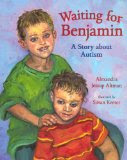
Review: Waiting for Benjamin

By Alexandra Jessup Altman; Illustrated By Susan Keeter

Albert Whitman & Co.; 2008; 32 pages

Picture Book; Realistic

Grade: K-4

ISBN: 978-0-8075-7364-8

Alexander finds himself getting increasingly frustrated with his younger brother Benjamin's behavior, until he is diagnosed with autism. At first giving into jealousy of all the attention Benjamin receives, Alexander learns patience and to appreciate Benjamin's small accomplishments.

My Thoughts:
I was initially excited to come across this book, since there are not very many books with autistic characters, and the few that do exist tend to portray the savant aspect of autism. I have a cousin who is autistic, and so am always looking for information. However, while this book is a step in the right direction, portraying a more typical autism experience, it still fell short. I worry that in some ways the book is still depicting stereotypical autistic behavior: the silence, the staring, the compulsive movements. It also shows Benjamin making rapid steps toward improvement once he is diagnosed. (And it doesn't ever explain why Benjamin's therapists come to the house rather than his going to their office...or why he gets to have 2 at once!)

In addition to story flaws, the technical aspects are not quite right either. The text explains the reactions of a fairly young older sibling. Alexander is a character that many 4 or 5 year olds would identify with. However, the text is written at a much higher level. It also discusses emotions from an abstract viewpoint that is beyond the developmental understanding of that age group. However, most older children will not identify with Alexander as much...recognizing the infantile nature of his jealousy and pettiness. In addition, most younger children will be turned off by the less than engaging illustrations while older children will be turned off by the presence of illustrations in the first place. I am glad that books are beginning to made available on this topic, and can only hope that better ones will follow this one soon.

The Thoughts of Others:

School Library Journal's Wendy Smith-D'Arezzo reviewed this book earlier this year. She pointed out that the progress Benjamin makes is not always realistic, and that the whole story's message is obvious. She did feel that it would work as a preliminary introduction for young children who have an autistic sibling.

Children's Literature's Karen Leggett saw the book as a "good icebreaker to help siblings and other youngsters understand autism and express their own feelings more openly."

Thursday, October 30, 2008

Review: Mother Goose's Little Treasures

By Iona Opie; Illustrated by Rosemary Wells

Candlewick Press; 2007; 56 pages

Picture Book; Mother Goose

Ages: 2-6

ISBN: 978-0-7636-3655-5

A collection of lesser known Mother Goose nursery rhymes paired with Rosemary Wells' signature illustrations.

My Thoughts:

Nursery Rhyme books, specifically Mother Goose, tend to all be the same. Shorter collections always default to the same handful of rhymes. In this book, however, Opie has chosen several rhymes that I had never seen before, and several that are lesser known. (Although, it should be pointed out, that for at least a few of them there might be good reasons for them being lesser known!) It was exciting to read this book, because you couldn't predict what the next page would bring. For parents, more interested in the history of nursery rhymes, there is an introductory letter from the author.

This is also a great read aloud book for younger audiences. The ratio of illustration to text is perfect. There are full page color illustrations that are usually paired with only a few lines of text. Some rhymes take 4 to 5 pages to play out. This makes it suitable for much shorter attention spans. Also, the illustrations themselves are charming. Children who are already familiar with Wells' bunnies will love to see them dancing along with children, cats, dogs, and poultry.

The Thoughts of Others:

School Library Journal's 2007 review did praise the work, but pointed out that since the rhymes are lesser known, the book is a non-essential addition to library and personal collections. They suggested only acquiring it after the previous two in Opie and Wells' series.

Lauralynn Persson also reviewed the book for Publisher's Weekly. She felt that the book was better suited to those who love nursery rhymes, rather than introducing new children to the genre. Also, while she appreciated the illustrations, she felt that they ended up being washed out in production.

Thursday, October 23, 2008

Review: Golem

By: David Wisniewski

Clarion Books; 1996; 32 pages

Picture Book; Caldecott Winner

Grades: 1-4

ISBN: 978-0618894246

A re-telling of the story of Rabbi Loew and how the Golem he created saved the Jews of medieval Prague from persecution and annihilation.

My Thoughts:
My first impression of this book was one of awe. I have made snowflakes before, I know how difficult paper cutting is. The detail and impact of the illustrations is awe-inspiring. I kept looking at the pictures and thinking about how much Wisniewski had to plan out each page...and wondering how many mistakes he had to discard. On the merits of its illustrations, I agree wholeheartedly with this book receiving the Caldecott Medal. But, then I turned to the text.

The Golem legend is a difficult one for children. The reason for the Golem's creation is disturbing, how the Golem goes about protecting the Prague Jews is violent, and the destruction of the Golem at the end is unsettling. Joseph is shown to be very child-like in his wonder and view of the surrounding world. I would have a hard time explaining to kids why he is not rewarded for his help, but rather is destroyed. (His pleadings to live are heart-wrenching.) Because of this, I do not recommend this book for a younger audience. I can think of a few situations where it would work though: introducing older kids to the topics of persecution (before discussing the Inquisition or even the Holocaust...especially with the historical note at the end, it is a good way to discuss the historical oppression of Jews.), or in an older student unit on legend, or religion, or Prague.

The Thoughts of Others:

Publisher's Weekly emphasized the beauty and the intricacy of the illustrations, justifying its Caldecott. However, they also point out, albeit positively that Wisniewski "emphasizes the Golem's humanity and the problems with his existence [and] allows for its historical and emotional complexity." They also appreciated the historical endnote.

Common Sense Media, a group who reviews books for families, was impressed by the illustrations, but felt that Wisniewski's book might be frightening or distressing to younger readers. In the end, they pointed out that readers who could handle the story matter would actually be better served byBashevis Singer's version of the tale, also entitled The Golem.

Friday, October 17, 2008

Review: Different Like Coco

By: Elizabeth Matthews

Candlewick Press; 2007; 40 pages

Picture Book; Non-Fiction; Biography

Age: Kindergarten - 3rd Grade

ISBN: 978-0-7636-2548-1

An illustrated biography of Coco Chanel which traces her life from her impoverished childhood through to her role as the Queen of Couture in Paris, while emphasizing her unique traits and individuality.

My Thoughts:

Disclaimer: I love picture book biographies. This is a great example of a biography for younger readers who will be interested to find out that the fun and spunky main character is a real person. Well executed, with engaging illustrations, the story admittedly varnishes over a few of the "earthier" details of Chanel's life. It only makes mention of one of her many gentleman friends, and gives a logical and positive reason for why the two of them do not live happily ever after. Chanel's historic and famous snobbery and elitism are explained, again with a positive spin. For children interested in all things fashion, the book does a great job of showing how revolutionary Chanel's designs were.

I appreciated that the text did not talk down to readers. Although the content was adjusted to match the age level of the readers, it was not cutesy or fake. The illustrations were friendly, inviting, and true to life. Chanel actually looks like Chanel, and her clothes are depicted in a historically accurate manner. I appreciated the timeline of Chanel's life which is included at the back of the book, but would have liked to see at least one photograph of Chanel, her designs, or even her boutique. I feel that this would have made it more apparent to young readers that the story is based on the life of a real person.

The Thoughts of Others:

The Publisher's Weekly Review raved about the illustrations and the storyline. They also point out how the book can function as an introduction to the historic time period, saying that it "offers a snapshot of European history through one extraordinary woman's life." Via Chanel, readers will learn about early feminism, fashion, war, and social class systems.

The School Library Journal review recommended the book for older readers than I did (grades 2-6). However, they made connections that I had not to other books. They felt that the book would appeal to the Fancy Nancy readership. Once they mentioned it, I began to see the connections between the young Coco that is depicted and the eponymous Nancy.

Thursday, October 16, 2008

Review: Scaredy Squirrel

By: Melanie Watt

Kids Can Press; 2006; 40 pages

Picture Book;

Award Winner: ALA’s Notable Children’s Book; Cybil; Schwartz Children's Book Award for Children’s Picture Book; Amelia Frances Howard-Gibbon Illustrator's Award; Blue Spruce Award

Ages: Preschool to 2nd Grade

ISBN: 978-1-55337-959-1

Scaredy Squirrel is afraid of absolutely everything, including green martians. He develops an emergency kit, an exit plan, and never leaves his tree. When Scaredy Squirrel is forced out into the world, he learns that "new" and "different" do not always mean "bad" and "scary." He finds his courage, and begins to embrace adventure.

My Thoughts:

This book should be dedicated to neurotics everywhere. As someone who has control issues, I was able to identify with the main character in strange and unusual ways. Scaredy Squirrel has an escape plan and an emergency kit which addresses every possible eventuality. (As a kid, I had a plan for what to do if my house was invaded by raptors from the Jurassic Park films.) What is great about this book, is that it doesn't minimize Scaredy Squirrel's fears. It doesn't ever diminish him as a squirrel for having them. Rather it shows how, by facing his fears, he is able to lead a richer and more fulfilling life. That is a concept that is important for kids. They need to know that it is ok to be afraid, but that they can face those fears. At the end of the book, Scaredy Squirrel is still nervous...he isn't "fixed" as one would suppose. The resolution comes from the fact that he is now willing to step away from his tree and try new things.

The text in this book is at a fairly simple level. It is engaging enough to make it a good read aloud book, but easy enough that insecure or early readers can try it on their own. The pictures are also incredibly engaging. They are extremely bold in their lines, and the colors (while limited) make a statement. Many books about fear depict the "scary" things in a dark and menacing way, that can actually CAUSE children to be more afraid. This book, however, shows them in a light and humorous way, that is very non-threatening. Children can empathize with Scaredy Squirrel without joining in his paranoia.

The Thoughts of Others:

Publisher's Weekly had a very positive 2006 review of Watt's book. They noted that she "largely dispenses with conventional visual storytelling," using instead "goofy charts and diagrams" which "spoof all the sincerely inane worksheets that are the staple of elementary school homework." (This was something I had not actively picked up on, but is useful in teaching literacy skills. Children need to learn to interpret diagrams and charts in addition to reading traditional text.)

School Library Journal also picked up on the plethora of diagrams versus standard text. They felt, in their 2006 review, that the main character was endearing, and that the humor would appeal to children.

Thursday, October 9, 2008

Review: Animalia

By: Graeme Base

Harry N. Abrams; 1987 (2004 reprint); 32 pages

Picture Book; Alphabet Book

Grades: Kindergarten thru Adult

ISBN: 0-8109-1939-7

A menagerie of animals romp through the alphabet doing all sorts of alliterative activities.

My Thoughts:

This is one of the most beautifully illustrated alphabet books I have ever clapped eyes on. It goes far beyond the "A is for Apple, B is for Ball" format of this genre's majority. Each letter is represented by a different animal doing something odd and interesting in an alliterative format. (For example: Diabolical dragons daintily devouring delicious delicacies.)

Honestly, the vocabulary is such that younger children will most likely be unable to read it independently. So, as far as its use as a typical alphabet book, it would be less than desirable. Yet, while the text may be over their heads, the beauty and intricacy of the illustrations will keep them enraptured! It also is a delightful read aloud book. The vocabulary can be made sense of through context and depiction. (I have never agreed with talking down to children. This book is a fun way to expose kids to words like: basking, impromptu, jovial, and upending.) Furthermore, the book can be used to teach older elementary students about the literary technique of alliteration.

The Thoughts of Others:

Aussie Reviews
had some very insightful comments about this classic in a review by Tash Williams. Tash described the animals images as "bizarre and interesting." Tash also noted the broad based appeal, citing that various age groups are "looking at the levels that are appropriate [to them]...unaware of shared levels within."

Publisher's Weekly also reviewed the book when it was originally released in the 80's. While the overall review was positive, they did point out a few of its shortcomings. These included that "it lacks a clear conceptual coherence or unity of action or meaning on every page."

Wednesday, October 8, 2008

Review: You Can't Take A Balloon Into The Metropolitan Museum

By: Jacqueline Preiss Weitzman and Robin Preiss Glasser

Dial Books for Young Readers; 1998; 37 pages

Picture Book; Wordless Book

Ages: 4 to 7

ISBN: 0-8037-2301-6

A girl is forced by a museum guard to leave her yellow balloon in his care while she tours the Metropolitan Museum. To his dismay, the balloon begins to fly away! The wordless picture book follows two narrative threads: the little girl's awe and wonder at the works of art, and the guard's desperate attempt to safely retrieve the errant balloon.

My Thoughts:
At first I was underwhelmed by this book. It was cute, and exposed children to fine art, but...meh. Then I showed it to one of my favorite 5 year olds...and he LOVED it. He is still in preschool, and appreciated having a book that HE could read to his mom. He told her the story while she looked at the pictures. Since the art is laid out in almost comic book format, I realized it was teaching him page awareness. He was having to follow the action from left to right, top to bottom. He was also learning sequencing, and narrative flow. It was amazing. All of a sudden I was looking at the book in a whole new light.

The art is absolutely enchanting. The pictures are lively, and packed with action. However, they are primarily black and white, with only the important and pertinant characters/action shown in color. The art at the Museum is actually the art at the museum spliced in. (There are photo reproductions of paintings and sculptures inset in the drawings.) My co-reviewer, the 5 year old, pointed out that the art the little girl is seeing actually mirrors the action that the balloon is doing...a painting of musicians precedes the balloon's encounter with a jazz band, a period wedding dress precede's the balloon's infiltration of a wedding party. (He is so observant!)

This book might not seem like much at first glance...but everytime I look at it I discover more gems tucked away in the illustrations. It is a feast for the eyes, and a book that actual children actually enjoy. (Which, in truth, is the best recommendation any children's material can receive!)

The Thoughts of Others:

Publisher's Weekly noticed all of the things that I had not. They truly enjoyed this book, and point out that "Glasser's drawings capture all the energy and charm of a captivating city."

Parent Council, a semi0-annual literary review that ceased publication in 2002, also reviewed the book in 2001. It was a very positive review. They note that it is a great introduction to art appreciation, helping children become familiar with pieces that make up Western Civilization's cultural canon. (Which reminded me of the Sesame Street episodes that introduced me to the Mona Lisa and other "great works.")

Friday, May 23, 2008

The Giving Tree

Today I did my fourth Story Time with Megan. Since I had the day off I drove to the Port Orchard branch office, where I used to work. They had wanted to hear a story as well. I did an adaptation in flannel of Shel Silverstein's The Giving Tree. I have posted the transcript to the right.

I know that this story is used to teach the importance of generosity. It shows kids that true happiness is found by giving, and by making others happy. But does it really? Ever since I was a little kid and first read the book I have thought that the boy was a creep. He takes and takes and never even thanks the tree. I almost feel that they story teaches kids to rip off those who look after them, and not express gratitude or care about what it costs others to help them. Still, it is a good story, and a modern classic. It is worth telling to children, but I would present it with a story that talks about being thankful/grateful for what we receive.

The performance went over well...although it was noted that this story was less of a warm fuzzy than the other stories I told. (Actually...one of my coworkers, Gail, was actually crying at the end. I didn't know whether to be pleased with the fact that I had moved her, or to feel bad because I made her cry...)

I need to thank my cousin Jake who is staying with me this weekend. He was my guinea pig audience several times when I practiced (pointing out mistakes and giving advice on wording), gave honest feedback on the flannel shapes, and then filmed the performance.

Tuesday, May 20, 2008

The Mitten

Today was the first "Storytime with Megan" at my work. I told my adaptation of Jan Brett's adaptation of The Mitten. The basic transcript is posted to the left. I followed her storyline, but the repetitive refrains that each animal uses are original to me.

I was very excited...I had knit two different sized mittens and cut all of the animals out of felt. It was a lot of prep work for an 8 minute story, but now I have the tools should I ever tell the tale again. (Although my sister, who just got her elementary ed degree seems to think she needs them...)

The work was worth it, because my coworkers were truly delighted. (And I like to think it was my storytelling, not the juice boxes and animal crackers that they loved.) They said that they had not expected me to do voices, and you can hear them chuckling in the background of the video. Afterwards several asked to look at the book, they wanted to get copies for their kids/grandkids.

Things I learned: Up-angles are not flattering! Grape is the most popular juice flavor! Wear a belt when telling this story, so that you have someplace to tuck the mittens!

Also, I need to thank Bill who filmed it for me. He was worried it would be shaky, but used a chair to prop the camera...maybe tomorrow I will take a tripod...

The video of the story is posted to the left!

Tuesday, May 13, 2008

Fell off the Couch

I went to the library yesterday on my way home from work and picked up a TON of picture books. I had placed a bunch on hold, and then literally went through the children's section grabbing anything with a slightly interesting title. I didn't even open most of them, and didn't get a chance to read any of them before bed last night.

I got off work early today, so decided to be productive. This involved sitting on my couch with some hot chocolate and a 2'4" stack of picture books on the floor next to me. (Yes, I actually measured.)

Most of the books ended up being a little bland. They just did not jump out and scream: "Use me for storytelling!"

A few did, quite literally, beg to be retold with flannel or felt...

One, however, actually made me laugh to the point of falling off the couch. (I don't know if it is really this funny, or if I am just sleep deprived and over-caffeinated.) It reminded me very much of Ugly Fish. I guess I just like off-beat, slightly vicious, grumpy story lines.

Anyway, the book is Grumblebunny by Bob Hartman. Everyone should go out and buy it...immediately...or at least get it at their local library!